

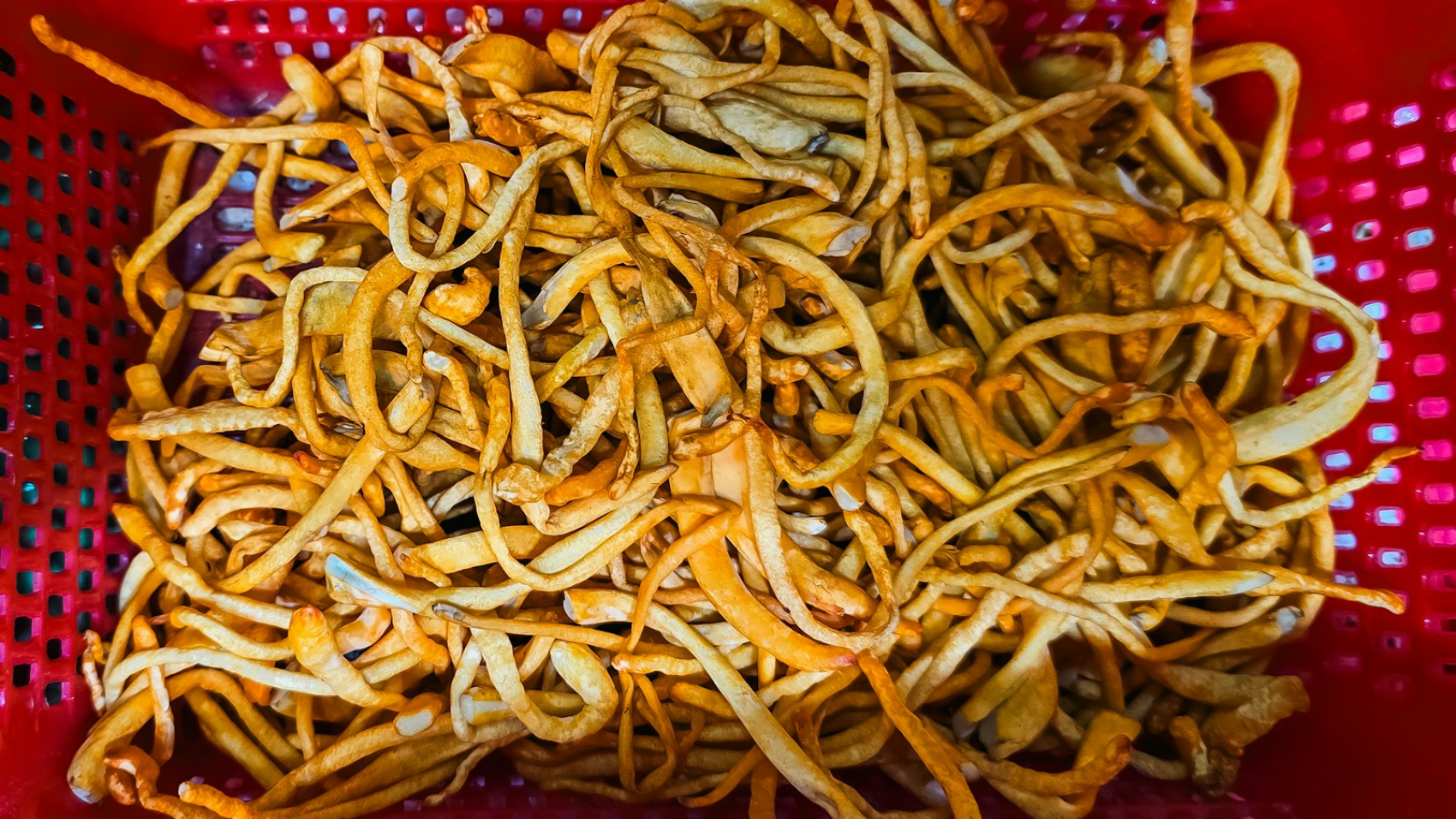
Cordyceps has one of the stranger life stories in the mushroom world. In the wild, the best known species grows out of moth caterpillars buried in high mountain meadows on the Tibetan Plateau, and it has been valued in Tibetan and Chinese medicine for centuries. These days you are more likely to see it mentioned by runners and gym goers. So what do we actually know? This article looks at where cordyceps comes from, what the human studies found, which findings are still limited to the lab, and how to approach it sensibly.
Key takeaways
- Two species dominate: wild Ophiocordyceps sinensis, which is rare and expensive, and the cultivated orange Cordyceps militaris.
- A handful of small human trials have looked at exercise, with some encouraging results in measures such as VO2max.
- A 2026 review of the C. militaris trials concluded the evidence is still too thin for firm recommendations.
- Most research on immunity and compounds such as cordycepin comes from cell and animal studies.
- Cordyceps may interact with blood thinners and diabetes medicines, so check with a pharmacist first if you take either.
What is cordyceps?
Cordyceps is a group of fungi, many of which grow on insects. The one with the long medicinal history is Ophiocordyceps sinensis, often still called Cordyceps sinensis. It infects the larvae of ghost moths underground, and the slender fruiting body pushes up through the soil in spring. In Tibet and Nepal it is known as yartsa gunbu, which roughly translates as summer grass, winter worm.
Wild O. sinensis is harvested by hand at high altitude, and a 2021 review in Frontiers in Pharmacology notes that overharvesting has made it increasingly scarce. Scientists have been working on ways to ferment and cultivate cordyceps since the 1970s for exactly this reason. The same review describes Cordyceps militaris, a bright orange, club shaped species found across East Asia, as the second most commercialised species and a cheaper alternative. It can be grown on grain or other substrates without any insects involved, which is why most cordyceps sold today is cultivated C. militaris or lab grown mycelium.
How cordyceps has been used traditionally
According to the Frontiers review, Tibetan medicine regards cordyceps as an important source of energy, and Chinese medicine has long used it as a tonic, particularly in relation to the lungs and kidneys. It was officially listed in the Chinese Pharmacopoeia in 1964. In the Himalayan regions, people have traditionally taken it dissolved in hot water, milk or alcohol, with amounts based on the experience of local practitioners.
That history is interesting and worth respecting, but tradition on its own does not tell us how well something works or for whom. That is where modern research comes in. Cordyceps sits alongside reishi and lion’s mane in the traditional toolkit, and it is one of the mushrooms our sister brand Mycology Nutrition works with. You can read about one of its better known relatives in our article on lion’s mane.
What human studies have found
Most interest in cordyceps today centres on energy and exercise, and this is the area with the most human data. It is still a small body of work, so the details matter.
Exercise in young adults
A 2017 trial published in the Journal of Dietary Supplements gave 28 young adults either 4g a day of a mushroom blend containing Cordyceps militaris or a placebo. The study was randomised and double blind. After one week there were no significant differences between the groups. Ten volunteers carried on for a further two weeks, and at the three week mark the mushroom group showed a significant rise in VO2max, a measure of how well the body uses oxygen during hard exercise, along with improvements in time to exhaustion. The authors suggested that any benefit may depend on taking it consistently over a longer period.
It is worth noting that the product was a blend of several mushrooms, so the results cannot be put down to cordyceps alone, and the three week group was very small.
Exercise in older adults
An earlier 2010 study in the Journal of Alternative and Complementary Medicine looked at Cs-4, a fermented cordyceps mycelium product. Twenty healthy adults aged 50 to 75 took either Cs-4 or a placebo every day for 12 weeks. The researchers reported improvements in metabolic and ventilatory thresholds, two markers of how comfortably the body copes as exercise gets harder. Again, this was a small group, and larger trials have not followed in the way you might hope.
Putting the trials together
The most up to date overview is a 2026 narrative review in the journal Nutrients, which gathered five human studies of C. militaris published between 2017 and 2024, covering 321 active people aged 16 to 35. Some studies reported gains in VO2max, time to exhaustion or power output, and some looked at markers of recovery after training. But the reviewers found the results were inconsistent, the studies were small and varied in design, none was judged to be at low risk of bias, and two used multi ingredient products. Their conclusion was that using cordyceps for exercise should be regarded as investigational rather than evidence based for now.
What lab and animal studies suggest
Cordyceps contains a range of active compounds, the best known being cordycepin, a molecule similar in structure to adenosine that is especially abundant in C. militaris. In laboratory work, cordycepin and cordyceps extracts have been studied for anti inflammatory and antioxidant activity and for effects on immune cells.
The Frontiers review is clear that most of this immune research comes from cell cultures and mouse models, and that human data are limited. Results in a dish or in mice are a useful starting point for scientists, but they cannot tell us whether eating cordyceps has the same effect in people, or at what dose. When you see bold claims online about cordyceps and immunity, this is usually the kind of evidence behind them.
Safety and quality
The Memorial Sloan Kettering Cancer Center herb database states that no major side effects have been reported. It does flag two possible interactions. Cordyceps may lower blood sugar, so taking it alongside insulin or other diabetes medicines could cause problems, and it may increase the risk of bleeding in people taking blood thinners such as warfarin. The Frontiers review also notes that some species in the wider Cordyceps family contain compounds that suppress the immune system, which is one reason to be cautious if you take immunosuppressant medicines.
Quality is the other thing to think about. Because wild O. sinensis is so costly, products vary widely in what they contain. A good label tells you the species, whether it uses the fruiting body or mycelium, and ideally how much cordycepin or other compounds it provides.
Practical takeaways
- Keep expectations realistic. The exercise findings are interesting but come from small studies, mostly in young, active people.
- Read the label. Look for the species name, the part of the fungus used and a clear amount per serving.
- Check your medicines. Speak to a pharmacist first if you take blood thinners, diabetes medicines or immunosuppressants.
- Give the basics priority. Sleep, regular training and good food will do far more for your energy than any single mushroom. Our guide to vitamin D in winter is a good place to start for the darker months.
When to speak to your GP or pharmacist
Get personal advice before trying cordyceps if you:
- Are pregnant, breastfeeding or planning a pregnancy, as there is little safety information for these groups
- Take medicines for diabetes, blood thinners or immunosuppressants
- Have an autoimmune condition, a bleeding disorder or are due to have surgery
- Are managing any long term health condition
Frequently asked questions
What is the difference between Cordyceps sinensis and Cordyceps militaris?
Ophiocordyceps sinensis is the wild species that grows on moth larvae in the Himalayas and has the longest traditional history. Cordyceps militaris is a related orange species that is easy to cultivate, much cheaper, and naturally rich in cordycepin. Most products on sale today use cultivated C. militaris or mycelium.
Does cordyceps improve exercise performance?
A few small trials have reported improvements in measures such as VO2max and time to exhaustion, especially after several weeks of use. A 2026 review concluded the results are inconsistent and the evidence is not yet strong enough for firm recommendations.
Is cordyceps safe?
No major side effects have been reported, but it may interact with diabetes medicines and blood thinners. There is little information on use during pregnancy or breastfeeding, so it is best avoided then unless a health professional advises otherwise.
How has cordyceps traditionally been taken?
In the Himalayan regions it has traditionally been dissolved in hot water, milk or alcohol, with amounts guided by the experience of local practitioners. Today it is more often sold as capsules or powders made from cultivated cordyceps.
Cordyceps is a good example of a traditional remedy that science is only beginning to test properly, and we will keep an eye on new trials as they appear. For more summaries of the evidence on herbs and mushrooms, visit our Research hub.
This article is for general information only. Please speak to your GP or pharmacist before starting any supplement, especially if you are pregnant, taking medication or managing a health condition.
Sources
- Das G et al. (2021). Cordyceps spp.: a review on its immune stimulatory and other biological potentials. Frontiers in Pharmacology, 11:602364.
- Hirsch KR et al. (2017). Cordyceps militaris improves tolerance to high intensity exercise after acute and chronic supplementation. Journal of Dietary Supplements, 14(1):42 to 53.
- Chen S et al. (2010). Effect of Cs-4 (Cordyceps sinensis) on exercise performance in healthy older subjects. Journal of Alternative and Complementary Medicine, 16(5):585 to 590.
- Jędrejko M et al. (2026). Current evidence of ergogenic and post exercise recovery effects of dietary supplementation with Cordyceps militaris in humans: a narrative review. Nutrients, 18(5):781.
- Memorial Sloan Kettering Cancer Center. Cordyceps. About Herbs database.